








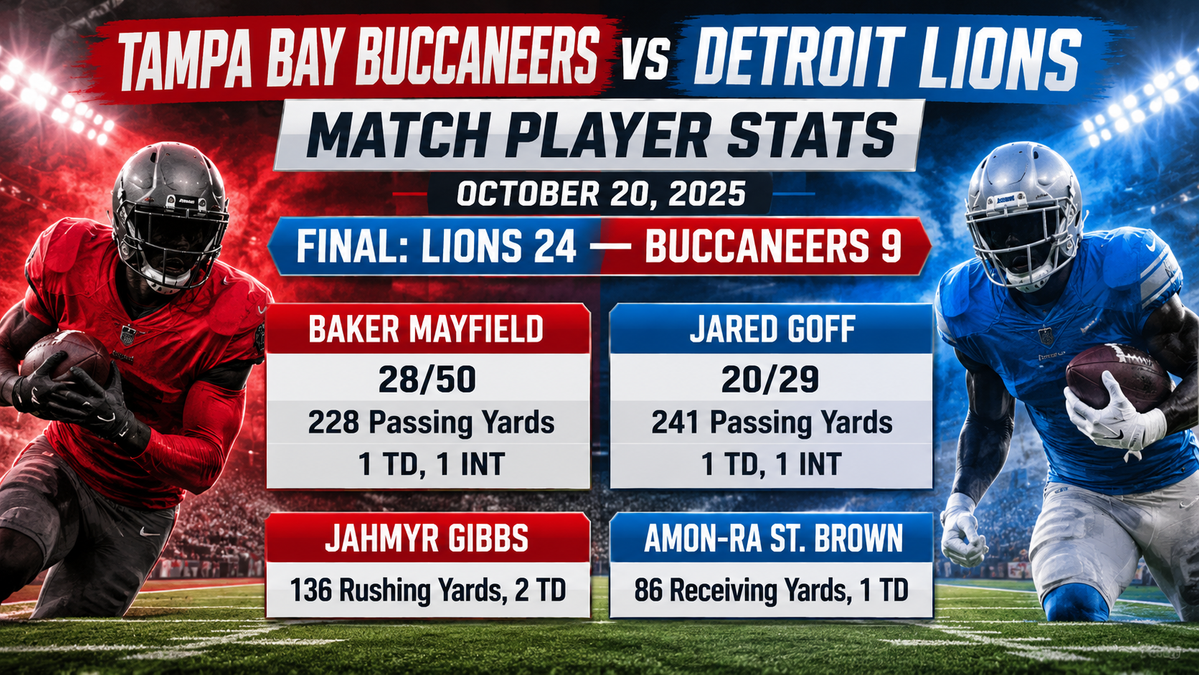
The tampa bay buccaneers vs detroit lions match player stats offer a fascinating look at how two talented NFL teams performed in a hard-fought regular-season game. The Detroit Lions defeated the Tampa Bay Buccaneers 24–9 on October 20, 2025, at Ford Field in Detroit, Michigan.
Although both teams entered the contest with strong hopes, Detroit found ways to control the game through its powerful running attack, smart passing, and strong defensive pressure. Tampa Bay showed determination, but the Buccaneers struggled to turn their opportunities into points.
This article provides a detailed review of the match, including quarterback statistics, rushing performances, receiving numbers, defensive contributions, and important team comparisons. It also explains what the numbers mean and why certain players made a greater impact than others.
Whether you’re an NFL fan, a sports blogger, a fantasy football player, or simply someone who wants to understand the game better, this guide will help you explore the match in a clear and informative way.
Tampa Bay Buccaneers vs Detroit Lions Match Overview
The game took place during Week 7 of the 2025 NFL regular season. Detroit hosted Tampa Bay at Ford Field, where the Lions used their home advantage to produce a strong performance.
The final score was 24–9 in favor of Detroit.
Match details
| Match information | Details |
| Match | Tampa Bay Buccaneers vs Detroit Lions |
| Date | October 20, 2025 |
| Competition | NFL regular season |
| Week | Week 7 |
| Stadium | Ford Field |
| Location | Detroit, Michigan |
| Final score | Detroit Lions 24, Tampa Bay Buccaneers 9 |
| Winning team | Detroit Lions |
| Losing team | Tampa Bay Buccaneers |
The official team box score confirms the final score and the main player statistics. <Cite refs={[“turn158400search2”]}/>
Detroit’s victory was built on a balanced offensive performance. The Lions gained 379 total yards, while Tampa Bay managed 251 yards.
That difference of 128 yards shows how much more effective Detroit was at moving the football.
However, the story goes beyond total yardage. Detroit also used its rushing attack to create explosive plays, while Tampa Bay struggled to maintain offensive rhythm.
Quarterback Stats: Jared Goff vs Baker Mayfield
Quarterbacks play a major role in NFL games because they lead the offense, make passing decisions, and help control the pace of the contest.
In this matchup, Jared Goff led the Detroit Lions, while Baker Mayfield served as the starting quarterback for Tampa Bay.
Both players threw for more than 200 yards, but their passing efficiency was different.
Jared Goff’s performance for Detroit
Jared Goff delivered a solid performance for the Lions.
He completed 20 of his 29 passing attempts for 241 yards, one touchdown, and one interception.
Goff’s completion rate was approximately 69 percent, which means he completed about seven out of every ten passes.
His performance helped Detroit move the ball down the field without needing to rely on passing plays for every offensive drive.
Goff’s passing statistics were:
| Statistic | Jared Goff |
| Completions | 20 |
| Attempts | 29 |
| Completion percentage | 69.0% |
| Passing yards | 241 |
| Touchdown passes | 1 |
| Interceptions | 1 |
| Yards per attempt | 8.3 |
One of Goff’s most important plays was his 27-yard touchdown pass to Amon-Ra St. Brown during Detroit’s opening drive.
This early score gave the Lions confidence and helped establish control of the game.
Although Goff threw an interception and lost a fumble during the first half, Detroit’s running game and defense helped prevent those mistakes from becoming a major problem.
Baker Mayfield’s performance for Tampa Bay
Baker Mayfield completed 28 of 50 passing attempts for 228 yards, one touchdown, and one interception.
His completion percentage was 56 percent.
Mayfield attempted 21 more passes than Goff but finished with fewer passing yards.
This difference suggests that Tampa Bay relied heavily on shorter passing plays, while Detroit produced more yardage per attempt.
| Statistic | Baker Mayfield |
| Completions | 28 |
| Attempts | 50 |
| Completion percentage | 56.0% |
| Passing yards | 228 |
| Touchdown passes | 1 |
| Interceptions | 1 |
| Yards per attempt | 4.6 |
Mayfield faced a difficult situation because Tampa Bay struggled to establish a strong running game.
The Buccaneers also lost wide receiver Mike Evans to injury during the first half, which reduced their available receiving options.
Despite these challenges, Mayfield continued trying to move the ball and helped Tampa Bay score its only touchdown.
Quarterback comparison
Goff was more efficient, while Mayfield completed more passes.
However, completing more passes does not always mean a quarterback has performed better.
A quarterback must also create enough yardage, protect the football, and help the offense score.
Goff’s 8.3 yards per attempt compared with Mayfield’s 4.6 yards per attempt was an important difference in this contest.
Rushing Stats: Jahmyr Gibbs Leads the Lions
The rushing game was one of the biggest reasons Detroit won this matchup.
Jahmyr Gibbs produced an outstanding performance, using his speed and movement to create large gains.
The Lions finished with 164 rushing yards, while Tampa Bay managed only 41.
That difference helped Detroit control the game and reduced the pressure on Goff to throw the ball on every drive.
Jahmyr Gibbs’ outstanding performance
Gibbs was Detroit’s leading rushing player.
He carried the football 17 times for 136 yards and two touchdowns.
His average was eight yards per carry, an excellent result for a running back.
| Statistic | Jahmyr Gibbs |
| Rushing attempts | 17 |
| Rushing yards | 136 |
| Average yards per carry | 8.0 |
| Rushing touchdowns | 2 |
| Longest run | 78 yards |
Gibbs’ longest run covered 78 yards.
That explosive play was one of the most important moments of the match because it helped Detroit gain a major advantage.
His ability to find open space and accelerate past defenders made him difficult to stop.
Gibbs also contributed as a receiver, catching three passes for 82 yards.
His combined rushing and receiving production made him one of the most influential players on the field. <Cite refs={[“turn158400search2”]}/>
David Montgomery’s contribution
David Montgomery also helped Detroit’s rushing attack.
He carried the ball 13 times for 21 yards.
Although his rushing numbers were modest, Montgomery helped the Lions maintain their offensive structure.
Running backs do more than gain yards. They can also help block defenders, protect the quarterback, and keep the offense balanced.
Detroit’s combination of Gibbs and Montgomery gave the team two different rushing styles.
Gibbs brought speed and explosive movement, while Montgomery provided a more physical running option.
Tampa Bay’s rushing performance
Tampa Bay struggled to create rushing opportunities.
Rachaad White led the Buccaneers with 10 carries for 38 yards.
His average was 3.8 yards per carry.
Sean Tucker had one carry for four yards, while quarterback Teddy Bridgewater recorded one rushing attempt for minus one yard.
| Tampa Bay player | Attempts | Yards | Touchdowns |
| Rachaad White | 10 | 38 | 0 |
| Sean Tucker | 1 | 4 | 0 |
| Teddy Bridgewater | 1 | -1 | 0 |
The Buccaneers finished with only 41 rushing yards.
This limited production made it harder for Tampa Bay to control the clock and create favorable passing situations.
When a team cannot run the football effectively, the defense can focus more attention on stopping the quarterback.
Receiving Stats: Amon-Ra St. Brown and Cade Otton
Wide receivers and tight ends play important roles in the passing game.
Their job is to catch the football, gain yards, and help the offense move toward the end zone.
In this match, Amon-Ra St. Brown led Detroit’s receiving attack, while Cade Otton was Tampa Bay’s leading receiver.
Amon-Ra St. Brown’s performance
St. Brown caught six passes for 86 yards and one touchdown.
His longest reception covered 27 yards.
He was especially important during Detroit’s opening drive, when he caught Goff’s touchdown pass.
That early score helped the Lions establish momentum.
| Statistic | Amon-Ra St. Brown |
| Receptions | 6 |
| Receiving yards | 86 |
| Average yards per reception | 14.3 |
| Touchdowns | 1 |
| Longest reception | 27 yards |
St. Brown’s performance showed why he is such an important part of Detroit’s offense.
He can find space between defenders, catch difficult passes, and create opportunities for his quarterback.
Cade Otton’s performance
Cade Otton was Tampa Bay’s leading receiver.
He caught seven passes for 65 yards.
His longest reception covered 20 yards.
Otton’s seven receptions were the highest total among Tampa Bay’s receivers in the game.
| Statistic | Cade Otton |
| Receptions | 7 |
| Receiving yards | 65 |
| Average yards per reception | 9.3 |
| Touchdowns | 0 |
| Longest reception | 20 yards |
Otton helped Mayfield complete several short passes.
However, Tampa Bay needed more explosive plays to challenge Detroit’s lead.
Although Otton made useful contributions, the Buccaneers struggled to turn their passing production into touchdowns.
Tez Johnson scores Tampa Bay’s touchdown
Tez Johnson provided Tampa Bay’s only touchdown.
He caught a 22-yard touchdown pass from Mayfield.
Johnson finished the game with four receptions for 58 yards and one touchdown.
His score gave Tampa Bay a moment of hope, but Detroit continued to control the game.
Johnson’s performance showed how a single explosive play can make a difference, even when a team is struggling overall.
Tampa Bay Buccaneers vs Detroit Lions Match Player Stats: Complete Receiving Table
The following table provides a closer look at the main receiving performances.
| Player | Team | Receptions | Yards | Touchdowns |
| Amon-Ra St. Brown | Lions | 6 | 86 | 1 |
| Jahmyr Gibbs | Lions | 3 | 82 | 0 |
| Brock Wright | Lions | 3 | 23 | 0 |
| David Montgomery | Lions | 2 | 18 | 0 |
| Kalif Raymond | Lions | 3 | 17 | 0 |
| Sam LaPorta | Lions | 3 | 15 | 0 |
| Cade Otton | Buccaneers | 7 | 65 | 0 |
| Emeka Egbuka | Buccaneers | 4 | 58 | 0 |
| Tez Johnson | Buccaneers | 4 | 58 | 1 |
| Sterling Shepard | Buccaneers | 7 | 25 | 0 |
| Rachaad White | Buccaneers | 4 | 6 | 0 |
These statistics show that Detroit had several players who contributed to its passing attack.
The Lions did not depend on one receiver alone. Instead, they spread the football across different players and used Gibbs as both a runner and receiver.
Team Statistics: Detroit’s Offensive Advantage
Team statistics help explain why one side won the game.
Detroit finished with 379 total net yards, compared with Tampa Bay’s 251.
The Lions also had a longer time of possession, which means they controlled the football for more time during the game.
Team comparison table
| Team statistic | Buccaneers | Lions |
| Final score | 9 | 24 |
| Total net yards | 251 | 379 |
| Penalties | 6 | 6 |
| Penalty yards | 35 | 50 |
| Time of possession | 28:21 | 31:39 |
| Rushing yards | 41 | 164 |
| Net passing yards | 210 | 215 |
Detroit gained 128 more total yards than Tampa Bay.
The biggest difference was in rushing production.
Detroit gained 164 rushing yards, while Tampa Bay managed only 41.
This difference allowed the Lions to create more balanced offensive drives.
The Buccaneers, meanwhile, relied heavily on Mayfield’s passing game.
That made the offense easier to defend, especially when Detroit’s defensive players were able to create pressure. <Cite refs={[“turn158400search2″,”turn158400search8”]}/>
Defensive Player Stats and Important Contributions
Defense is an important part of football because it prevents the opposing team from scoring.
Defensive players try to tackle runners, pressure quarterbacks, stop passes, and force turnovers.
Both teams recorded four sacks in this match.
A sack happens when a defensive player tackles the quarterback behind the line of scrimmage before the quarterback can throw a pass.
Detroit’s defensive pressure
Detroit’s defense helped control Tampa Bay’s offense.
The Lions recorded four sacks and limited the Buccaneers to only nine points.
The pressure also made it difficult for Mayfield to complete longer passing plays.
Detroit’s defensive players included:
- Jack Campbell
- Derrick Barnes
- Tyrus Wheat
- Al-Quadin Muhammad
These players contributed to the Lions’ defensive pressure during the match. <Cite refs={[“turn158400search8”]}/>
Detroit also benefited from strong defensive teamwork.
The Lions were able to pressure Mayfield while keeping the Buccaneers from establishing a consistent rushing attack.
Tampa Bay’s defensive effort
Tampa Bay’s defense also recorded four sacks.
This shows that the Buccaneers were able to create pressure against Goff.
However, Detroit’s rushing attack continued to produce large gains.
Gibbs’ 78-yard run was especially damaging because it allowed the Lions to create a major offensive advantage.
Even when a defense makes several good plays, one explosive run or pass can change the direction of a game.
Quarter-by-Quarter Scoring Analysis
The final score was 24–9, but the way the points were scored tells a more complete story.
Detroit started strongly and maintained control throughout the game.
Tampa Bay struggled to score during the first three quarters.
Quarter scoring table
| Quarter | Buccaneers | Lions |
| First quarter | 0 | 7 |
| Second quarter | 3 | 7 |
| Third quarter | 6 | 7 |
| Fourth quarter | 0 | 3 |
| Total | 9 | 24 |
Detroit scored a touchdown in each of the first three quarters.
That helped the Lions build a comfortable lead.
Tampa Bay scored three points in the second quarter and six points in the third quarter.
The Buccaneers were unable to score during the fourth quarter.
Detroit added a field goal in the final quarter to complete the 24–9 victory. <Cite refs={[“turn158400search2”]}/>
Why the first quarter mattered
Detroit’s opening touchdown helped establish momentum.
The Lions showed that they could move the ball through the air and create scoring opportunities early.
Tampa Bay, on the other hand, failed to score in the opening quarter.
This created pressure on the Buccaneers to catch up.
Detroit maintained control
Detroit’s ability to score consistently prevented Tampa Bay from building a comeback.
The Lions continued to use their running game and passing attack to keep the offense moving.
The Buccaneers had opportunities, but they could not convert enough of them into touchdowns.
Key Moments That Changed the Match
Several moments helped determine the final result.
Gibbs’ explosive 78-yard run
Jahmyr Gibbs’ 78-yard run was one of the most important plays of the game.
It showed Detroit’s ability to create big plays on the ground.
The run also forced Tampa Bay to pay greater attention to the Lions’ rushing attack.
Goff’s touchdown pass to St. Brown
Goff’s 27-yard touchdown pass to St. Brown helped Detroit begin the game with confidence.
The early score placed pressure on Tampa Bay and gave Detroit a strong start.
Tampa Bay’s limited rushing production
The Buccaneers finished with only 41 rushing yards.
This made it harder for the team to create balanced offensive drives.
As a result, Mayfield had to attempt many more passes than Goff.
Detroit’s defensive pressure
The Lions recorded four sacks and limited Tampa Bay’s ability to move the ball consistently.
Their defensive pressure helped keep the Buccaneers from producing a stronger comeback.
What the Player Statistics Tell Us About the Match
Statistics help explain the reasons behind a football result.
However, numbers should always be understood in the context of the game.
For example, Mayfield completed 28 passes, which was more than Goff’s 20 completions.
At first glance, this might suggest that Mayfield had the stronger passing performance.
But Goff produced 241 yards on 29 attempts, while Mayfield gained 228 yards on 50 attempts.
Goff was able to gain more yards with fewer throws.
This demonstrates the importance of passing efficiency.
Important lessons from the statistics
The game provides several useful lessons:
- A strong rushing attack can reduce pressure on a quarterback.
- Explosive plays can create major advantages.
- Passing efficiency matters more than the number of completed passes alone.
- Defensive pressure can stop an offense from developing a rhythm.
- A balanced offense is often harder to defend.
- Time of possession can help a team control the pace of the game.
Detroit performed well in several of these areas.
The Lions used their rushing attack, passing game, and defense to create a balanced performance.
Tampa Bay showed effort, but its offense needed more consistency.
What This Match Means for Both Teams
A single NFL game does not decide an entire season, but it can provide important lessons.
For Detroit, the victory showed how effective the team could be when its running game and passing attack worked together.
Gibbs was especially important because he produced 136 rushing yards, two rushing touchdowns, and 82 receiving yards.
Goff also helped the Lions maintain offensive balance.
For Tampa Bay, the game showed the importance of improving rushing production and creating more explosive passing opportunities.
Mayfield completed 28 passes, but the offense struggled to turn those completions into enough points.
The Buccaneers also faced challenges after losing Evans during the first half.
Still, the game offered useful information for both teams as they continued through the season.
Frequently Asked Questions
Who won the Tampa Bay Buccaneers vs Detroit Lions match?
The Detroit Lions defeated the Tampa Bay Buccaneers 24–9 on October 20, 2025.
How many passing yards did Jared Goff have?
Jared Goff completed 20 of 29 passes for 241 yards, one touchdown, and one interception.
How many passing yards did Baker Mayfield have?
Baker Mayfield completed 28 of 50 passes for 228 yards, one touchdown, and one interception.
Who was the leading rusher in the match?
Jahmyr Gibbs was the leading rusher. He carried the ball 17 times for 136 yards and two touchdowns.
Who was the leading receiver for Detroit?
Amon-Ra St. Brown led Detroit with six receptions for 86 yards and one touchdown.
Who was the leading receiver for Tampa Bay?
Cade Otton led Tampa Bay with seven receptions for 65 yards.
How many total yards did Detroit gain?
Detroit gained 379 total net yards, while Tampa Bay gained 251.
What was the biggest difference between the teams?
The biggest difference was rushing production. Detroit gained 164 rushing yards, while Tampa Bay gained only 41.
When is the next Buccaneers vs Lions game?
The next scheduled meeting is November 22, 2026, at Ford Field in Detroit. The final player statistics for that game are not available before kickoff. <Cite refs={[“turn158400search0″,”turn158400search10”]}/>
Final Thoughts on Tampa Bay Buccaneers vs Detroit Lions Match Player Stats
The tampa bay buccaneers vs detroit lions match player stats reveal how Detroit used a balanced offense, explosive rushing plays, and strong defensive pressure to secure a 24–9 victory.
Jared Goff completed 20 of 29 passes for 241 yards and one touchdown, while Baker Mayfield finished with 228 passing yards and one touchdown.
Jahmyr Gibbs was the standout performer. His 136 rushing yards, two rushing touchdowns, and 82 receiving yards made him one of the most influential players in the contest.
Amon-Ra St. Brown also played an important role with six receptions for 86 yards and a touchdown.
For Tampa Bay, Cade Otton and Tez Johnson made useful contributions, but the Buccaneers struggled to create enough offensive momentum.
The match demonstrated an important football lesson: winning requires more than one talented player. Strong teamwork, efficient passing, effective rushing, and reliable defense all play a role.
Ultimately, the tampa bay buccaneers vs detroit lions match player stats provide a clear picture of Detroit’s performance and explain why the Lions were able to control the game from start to finish.
Stay in touch to get more updates & news on Trend Info Here!
